Examples
McCormick Function
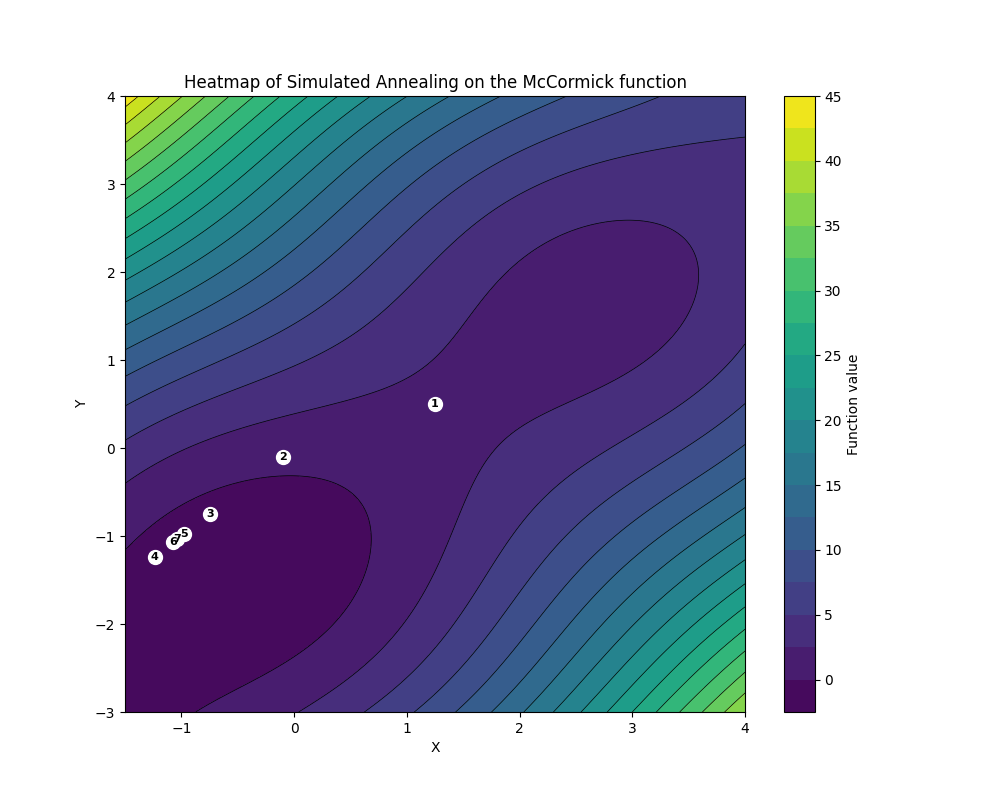
The McCormick function is a multimodal function that is commonly used to test optimization algorithms. It is defined as f(x,y) = sin(x + y) + (x - y)**2 - 1.5*x + 2.5*y + 1 along the domain [-1.5, 4] x [-3, 4]. The global minimum of this function is located at f(-0.54719, -1.54719) = -1.9133.
We implement the McCormick function as follows:
import numpy as np
def objective(params):
    x, y = params
    return np.sin(x + y) + (x - y)**2 - 1.5*x + 2.5*y + 1
We then set our initial guess to the center of the search space:
initial_guess = [1.25, 0.5]
We define our neighbor function to perturb our current solution by a random normal variable with mean 0 and standard deviation 1:
import random
def neighbor(params):
    new_params = params[:]
    index = random.randint(0, len(params) - 1)
    new_params[index] += random.normalvariate(0, 1)
    new_params[0] = max(-1.5, min(4, new_params[0]))
    new_params[1] = max(-3, min(4, new_params[0]))
    return new_params
Finally, we run the simulated annealing algorithm. We choose to run the algorithm for 200 iterations, alongside the default temperature schedule:
from quickopt.annealing import anneal_double
result = anneal_double(funct=objective, initial=initial_guess, neighbor=neighbor, iterations=200, verbose=0)
The following is a heatmap of the optimization process, with each point representing a new optimal solution found by the algorithm: